
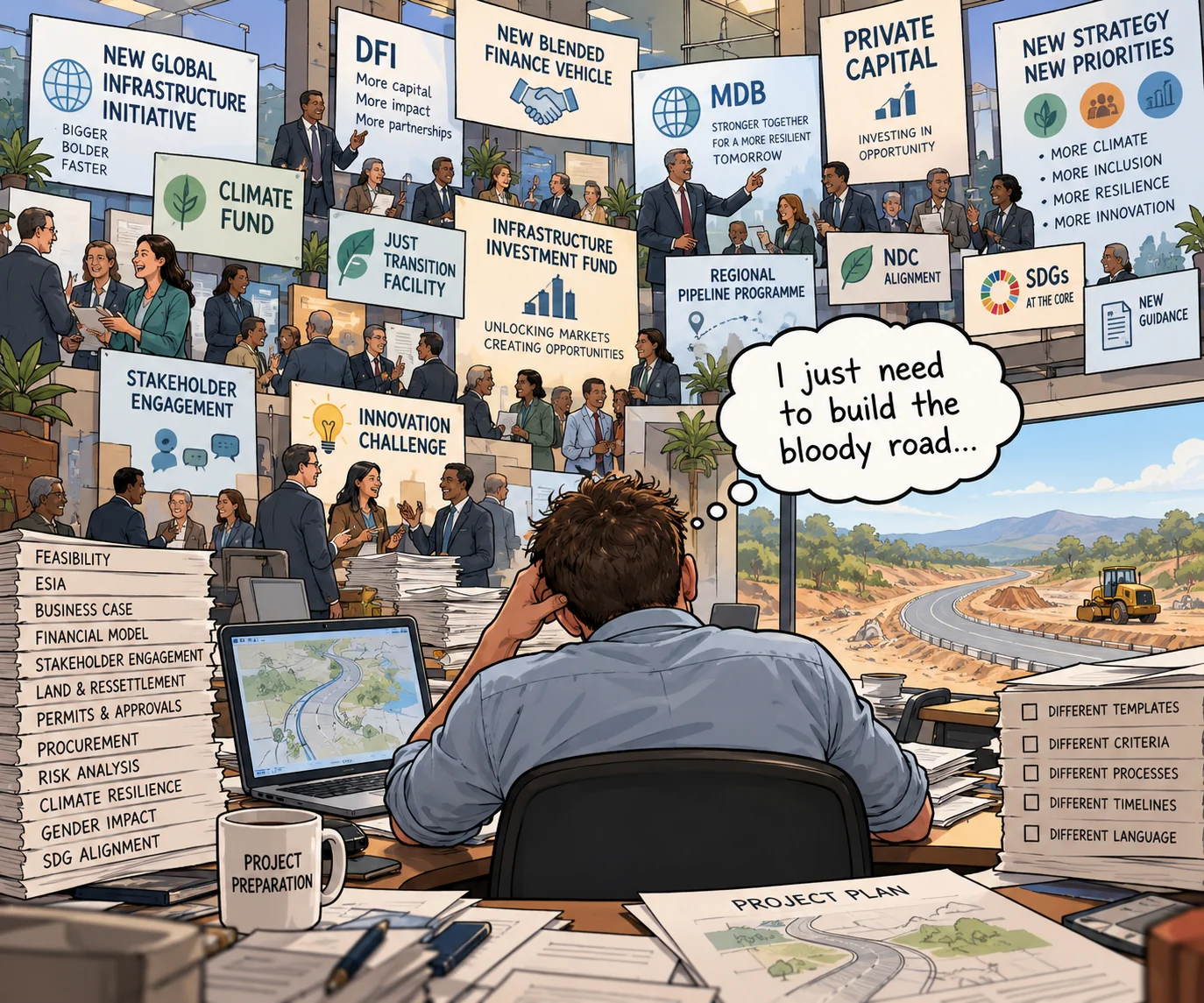
For as long as I can remember working in infrastructure and development, I’ve heard some version of the same conversation at conferences around the world.
“We need to get more private capital into emerging markets.”
Then, increasingly:
“There’s no shortage of capital. There’s a shortage of bankable projects.”
Fair enough.
But this is where the buzzing becomes very frustrating.
Because once we’ve agreed that we don’t have enough investable projects, an awful lot of the conversation seems to go straight back to… capital.
How do we mobilise institutional investors? What should MDBs do? What should DFIs do? Do we need more guarantees? More blended finance? Who should take which bit of risk?
All important questions.
But meanwhile, somewhere in the middle of all of this, there is someone actually trying to develop a project.
And I’m not sure we spend enough time thinking about what the world looks like from their side of the table.
It is, frankly, hellishly complicated.
Should they be talking to an MDB? A DFI? Government? A commercial bank? An infrastructure fund? A climate fund? A philanthropic investor?
One institution wants to understand the wider economic benefits.
Another needs to see development additionality.
Someone else wants climate impact, environmental and social safeguards, gender outcomes or alignment with the SDGs.
And the commercial investor quite reasonably wants to know: how am I getting my money back?
Different institutions. Different requirements. Different language. Different processes.
And increasingly, not a huge amount of money around to help the project sponsor navigate any of it.
There’s another slightly uncomfortable part of this conversation too.
Development finance has done an extraordinary job of helping create markets and proving that investing in emerging markets can work.
But when those markets mature, are we always good enough at stepping back and letting private capital take more of the load?
Because if relatively cheap DFI capital is available for a perfectly investable project, it shouldn’t surprise us if a sponsor chooses it over more expensive commercial capital.
Equally, I’ve heard plenty of private investors say that working alongside the development finance system can be complicated, slow and confusing.
So everyone gets a little frustrated with everyone else.
And the poor project sponsor is still standing in the middle asking:
Can somebody just help me get this project ready?
There is some fantastic project preparation work happening around the world, so I don’t want to unfairly caricature the whole system.
But I do wonder whether we sometimes make this more complicated than it needs to be.
Maybe we spend too much time debating the perfect architecture of global infrastructure finance and not enough time on the rather more mundane business of getting good projects through the messy middle of project preparation.
Most project sponsors I’ve worked with don’t want another global framework.
They want some fairly practical answers:
Is this actually a good project?
What am I missing?
What do I need to do next?
Who might finance it?
What will they need to see?
And where can I get some decent help without spending a fortune or doing cartwheels to access it?
Perhaps solving that won’t magically close the infrastructure financing gap.
But I have a sneaking suspicion it would help.
Anyway. Bee released from bonnet. For now.